Some people finish a word search in ten minutes. Others stare at the same grid for an hour. The difference is rarely intelligence — it is strategy. Fast solvers use a handful of techniques, consciously or not, that slow solvers never learned. Here are nine proven strategies that will speed up your solving on any grid.
1. Scan for the first letter first
Do not hunt for the whole word. Scan the entire grid for the word’s first letter, and check each occurrence for the second letter. This two-step scan is dramatically faster than trying to “see” the full word at once.
2. Start with the rare letters
Words containing Q, X, Z, J, or K are gifts — those letters appear so rarely in a grid that finding one usually means finding the word. Always solve rare-letter words first; it thins the grid for everything else.
3. Follow the letter pattern, not just the letter
Your eyes are good at patterns. Once you find “S-T,” scan for the distinctive shape of the next letter rather than reading every cell. With practice, your peripheral vision starts flagging likely spots automatically.
4. Group words by length
Solve the longest words first. Long words are easier to spot (they span more of the grid) and removing them clears visual clutter, making short words easier to find. Save 3-letter words for last.
5. Work row by row, then column by column
Random scanning misses things. Do one systematic horizontal pass across every row, then one vertical pass down every column. Boring? Yes. Effective? Enormously. Most “impossible” words are found on the systematic pass.
6. Check the diagonals deliberately
Diagonal words hide in plain sight because our eyes prefer straight lines. After your row and column passes, do a dedicated diagonal sweep — top-left to bottom-right, then top-right to bottom-left. You will be amazed what appears.
7. Circle as you go — and mark found letters
Circle or highlight each found word completely. Some solvers also lightly cross out letters that cannot start any remaining word. A clean, marked grid is a fast grid; a messy one forces your eyes to re-scan solved territory.
8. Use a highlighter, not a pen
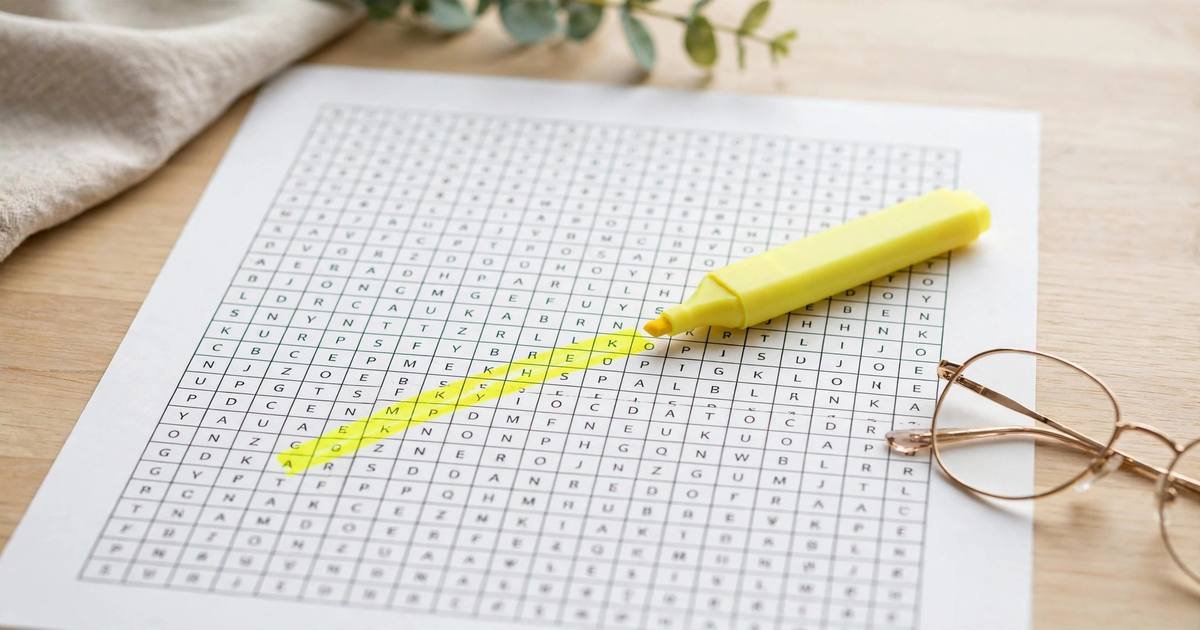
A broad highlighter tip covers words faster than circling with a pen, and the color makes found words visually “disappear” so your eyes skip them. Yellow is the classic for a reason — it is bright without obscuring letters.
9. Skip and return
Stuck on a word for more than a minute? Move on. Fresh eyes find hidden words in seconds — it is one of the most reliable phenomena in puzzle solving. Solve everything else, then return to the stubborn ones with a thinned-out grid.
Common mistakes that slow you down
The biggest time-waster is re-scanning solved territory — it happens when found words are not clearly marked. The second is hunting for 3-letter words first; short words are the hardest to spot in a full grid and the easiest in a thinned one. The third is staring: if your eyes have been on the same quadrant for a minute, physically rotate the page. A new angle genuinely helps your brain see new patterns. And finally, do not solve in poor light. Eyestrain slows everyone down, which is one reason large-print puzzles are so popular with regular solvers.
A 7-day speed training plan
Day 1–2: solve two puzzles using only strategy 1 (first-letter scanning) and strategy 8 (highlighter). Day 3–4: add the rare-letters-first and longest-first rules. Day 5–6: practice the systematic row/column/diagonal passes on every puzzle. Day 7: time yourself on a fresh puzzle and compare with day 1. Most solvers see a dramatic difference within the week — not because they got smarter, but because they got systematic.
Putting it together
The full routine: rare-letter words first, then longest to shortest, first-letter scanning, systematic row/column passes, a dedicated diagonal sweep, and strategic skipping. Practice it on five puzzles and it becomes automatic — and your solve times will drop noticeably.
Now grab a grid and put these to work. The only way to get faster is to solve.
Practicing with kids? Our sister site has a free printable vehicles word search for kids — 20 puzzles about things that go, perfect for young solvers learning these same skills.